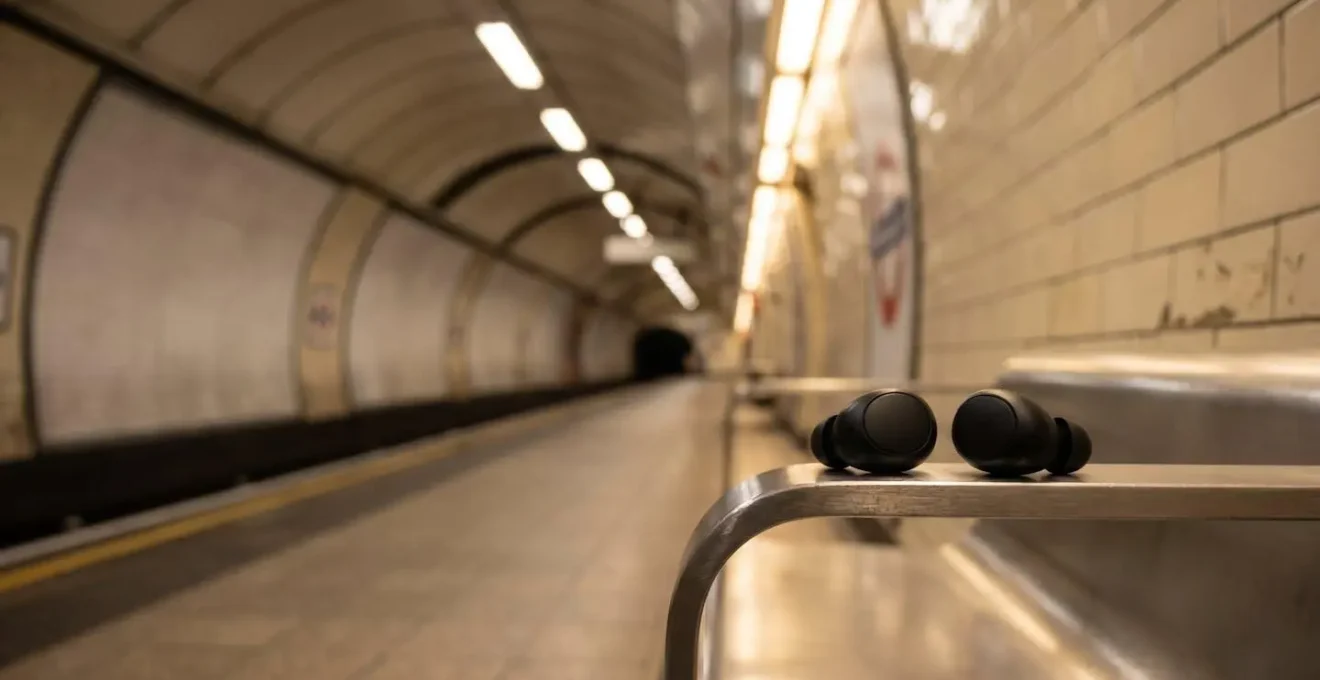
Active Noise Cancellation (ANC) is a critical tool for protecting your hearing on the Tube, but only if you understand its limitations and use it correctly.
- ANC excels at cancelling low-frequency train rumbles, not the high-frequency sounds of announcements or alarms.
- A perfect ear tip seal is non-negotiable; without it, protection is drastically reduced and you’ll instinctively increase the volume, defeating the purpose.
Recommendation: Use a “fit test” to guarantee a proper seal and learn to combine ANC with a well-tuned Transparency Mode to create a safe and personalised auditory environment for your commute.
The sudden roar of an approaching train on the London Underground is a universally shared assault on the senses. For decades, the commuter’s response was simple: turn up the volume on their headphones, further damaging their hearing in a futile attempt to drown out the noise. Active Noise Cancellation (ANC) headphones arrived as a seeming miracle, promising a quiet oasis in the chaos. The common wisdom is that by eliminating background noise, ANC allows you to listen at a safer, lower volume, thus protecting your hearing.
While this is broadly true, as an audiologist, I must caution that the reality is far more nuanced. ANC is not a magic shield; it is a sophisticated audiological tool. Its effectiveness is entirely dependent on how it’s used and, more importantly, a proper understanding of its physical and psychoacoustic limitations. Simply putting on ANC headphones without proper setup can provide a false sense of security and even introduce new, subtle risks. True hearing protection doesn’t come from just owning the technology, but from mastering it.
This guide will move beyond the marketing claims. We will explore the science of how ANC selectively filters your reality, teach you how to ensure you’re getting a clinically effective seal, decode the strange side effects like “eardrum suck,” and provide practical strategies for navigating the urban soundscape safely. Your hearing health is a long-term investment, and your commute is a daily opportunity to protect it.
Contents: Does Noise Cancellation Protect Your Hearing on the Tube? A Clinical Perspective
- Why Does ANC Block Train Rumbles but Not Announcement Voices?
- How to Use the “Fit Test” to Ensure You Are Actually Protected?
- The “Eardrum Suck” Feeling: Why ANC Makes You Nauseous?
- Passive Isolation or Active Cancellation: Which Is Safer for Walking in London?
- How to Tune Transparency Mode to Hear Cars but Not Wind?
- The Neck Pain Mistake 80% of Commuters Make While Working
- How to Navigate the Underground Without Signal?
- Google Maps vs Citymapper: Which Is Best for London Commuting?
Why Does ANC Block Train Rumbles but Not Announcement Voices?
The primary function of Active Noise Cancellation is not to create silence, but to target and eliminate a specific type of sound: constant, low-frequency noise. This is achieved through a remarkable process of destructive interference. Microphones on the outside of your headphones capture the surrounding sound, and a processor inside instantly creates an inverted sound wave—a perfect “anti-noise”—which is then played into your ears. When the original noise wave and the new anti-noise wave meet, they cancel each other out.
The key to this process lies in the frequency. As this schematic visualization suggests, low-frequency sounds, like the deep rumble of a train, have long, predictable wavelengths. This gives the ANC processor ample time to analyse the wave and generate its inverse. In fact, research demonstrates that active noise control systems are most effective in the range below 1000 Hz. In contrast, sudden, high-frequency sounds like a station announcement, a car horn, or a nearby conversation are far more complex and unpredictable. The wavelengths are shorter and change too rapidly for the ANC system to effectively counter them.
This is also where passive noise isolation—the physical barrier created by the earbuds themselves—plays a crucial role. A well-designed earbud can block 15-30dB of mid-to-high-frequency noise on its own. ANC technology then adds its power, capable of reducing low-frequency subway train noise by up to 60dB. It is this complementary partnership that creates the final effect: the low, monotonous roar of the Tube disappears, while the essential, higher-frequency announcements remain audible, albeit muffled.
How to Use the “Fit Test” to Ensure You Are Actually Protected?
The single most critical factor for both hearing protection and ANC effectiveness is not the brand of your headphones, but the quality of the seal the ear tips make in your ear canals. An improper seal creates a leak for outside noise to bypass the ANC system, but more dangerously, it allows low-frequency bass to escape. Your brain interprets this lack of bass as poor sound quality and instinctively prompts you to turn up the volume, directly negating any hearing protection benefit. An incomplete seal can result in a 10 to 20 dB loss in the sub-bass region, a massive deficit that you will subconsciously try to correct with volume.
Many modern headphones come with a software-based “fit test,” but as an audiologist, I encourage a more hands-on, physical verification. You must become an expert in how a perfect seal feels and sounds. This is not a one-time setup; you should be mindful of the seal every time you insert your earbuds, as small variations in placement can make a significant difference. It is the only way to be certain that you are getting the full, rated protection and can listen at a genuinely safe volume.
To move from hoping for a good fit to guaranteeing one, you need a repeatable protocol. The following steps provide a clinical method to audit your ear tip seal and ensure you are truly protected.
Your Clinical Checklist: Verifying the IEM Seal
- Initial Insertion: Insert the earbuds and play a low-frequency test tone (like a 60Hz sine wave, easily found online) or a bass-heavy song at a moderate, safe volume.
- The Pressure Test: Gently press each earbud slightly deeper into your ear. If the bass volume or richness increases significantly, your initial seal was inadequate. You’re looking for the point where further pressure yields no change in bass response.
- The Jaw-Movement Test: While audio is playing, open and close your mouth wide, as if yawning. A solid seal should maintain consistent bass levels. If the sound becomes thin or loses bass, the ear tips are either the wrong size or not a good material for your ear shape.
- Real-World Validation: The ultimate test is not in your quiet living room, but on the Tube. A seal that seems perfect in silence may fail under the pressure and vibration of the actual noisy environment.
- Tip Comparison: Systematically compare all included ear tip sizes (and materials, like foam vs. silicone if available). A change in size can dramatically alter the seal integrity and, consequently, the entire frequency response you perceive.
The “Eardrum Suck” Feeling: Why ANC Makes You Nauseous?
One of the most peculiar and unsettling side effects reported by new ANC users is a sensation of pressure or a “vacuum” in their ears, sometimes leading to dizziness or nausea. It’s often described as “eardrum suck.” This feeling is alarming because it mimics the sensation of changing altitude in a plane or diving underwater, leading many to worry that the headphones are creating dangerous pressure changes within the ear canal. From a clinical standpoint, it’s crucial to understand that this is a psychoacoustic illusion, not a physical danger. The actual change in air pressure caused by the headphone speakers is minuscule and harmless.
The true culprit is a fascinating mismatch between your brain and your senses. Your brain has spent your entire life associating the presence of strong, low-frequency sound with corresponding air pressure. The deep rumble of thunder or the thud of a heavy door closing are not just heard; they are felt. This is where the phenomenon of a vestibular-auditory conflict occurs. Intense, low-frequency sound can subtly stimulate the vestibular system in your inner ear, the organ responsible for balance. When ANC is activated, it instantaneously strips away this low-frequency auditory information that your brain expects to be there. The auditory system says “the pressure is gone,” while the vestibular system, which is no longer being subtly vibrated, agrees. Your brain interprets this sudden, unusual sensory void as a change in physical pressure, even though none has occurred.
The Sound Mavericks Research Team explains this perceptual trick with perfect clarity:
When ANC switches on and strips out that low-frequency content almost instantaneously, your brain notices an abrupt and unusual change in the acoustic environment. The brain associates changes in low-frequency sound pressure with changes in physical pressure — as with altitude or underwater depth — it can interpret this as a sensation of pressure or vacuum, even though your ear canal air pressure has barely moved.
– Sound Mavericks Research Team, Why Do Noise Cancelling Headphones Cause Pressure?
For most users, this sensation diminishes over time as the brain adapts to this new sensory input. However, for those who remain sensitive, choosing headphones with adjustable ANC levels can help, allowing for a more gradual introduction to the effect.
Passive Isolation or Active Cancellation: Which Is Safer for Walking in London?
Once you step off the Tube and onto the busy streets of London, the requirements for your auditory safety change completely. The goal is no longer to block out a single, monolithic roar, but to navigate a complex soundscape filled with both distractions and vital warning cues like sirens, bicycle bells, and approaching vehicles. This is where the distinction between passive noise isolation and Active Noise Cancellation becomes a critical safety consideration.
As we’ve established, passive isolation is a physical barrier that blocks sound across the frequency spectrum, particularly in the mid-to-high ranges. ANC, on the other hand, actively targets and removes low-frequency sounds. The danger with relying solely on ANC while walking is that it is fundamentally ineffective against sudden, transient sounds like a car horn. The system is designed for constant noise and cannot react fast enough. Therefore, a pedestrian’s safety depends on understanding which technology blocks which sounds, and when to use each.
The following table breaks down the characteristics of each technology from a pedestrian safety perspective, helping you make an informed choice for different parts of your commute.
| Feature | Passive Isolation | Active Noise Cancellation (ANC) |
|---|---|---|
| Frequency Range | 15-30dB reduction (mid to high frequencies) | Up to 60dB reduction (low frequencies below 1000 Hz) |
| Sudden Noise Response | Immediate physical blocking | Ineffective – cannot react to transient sounds like car horns |
| Safety for Walking | Blocks all frequencies equally including warning sounds | Allows high-frequency alerts through but blocks rumble |
| Battery Dependency | No power required | Requires active power consumption |
| Best Use Case | Stationary environments or combined with transparency mode | Constant low-frequency noise (trains, aircraft) |
How to Tune Transparency Mode to Hear Cars but Not Wind?
Transparency Mode is the safety-net of modern headphones. It uses the external microphones not to cancel noise, but to pass it through to your ears, allowing you to maintain situational awareness. However, anyone who has used it on a blustery day knows its greatest weakness: wind noise. Wind hitting the microphones creates a loud, disruptive roaring sound that can be just as distracting and unpleasant as the traffic noise you’re trying to monitor. The goal, then, is to achieve a state of “auditory triage,” where you can hear the important sounds (cars, voices) but filter out the unimportant ones (wind, general hum).
Achieving this balance requires moving beyond the default settings. Many premium headphones now offer adjustable levels of transparency or even “Adaptive” modes. Research has shown that advanced adaptive noise cancellation technology automatically adjusts to your environment, providing optimal listening in both busy subways and quiet offices. This same principle is being applied to transparency. If your headphones offer it, enabling an adaptive or “wind reduction” setting is the first and most effective step. This uses algorithms to identify the specific frequency signature of wind turbulence and selectively reduce it, while leaving other environmental sounds intact.
If your device lacks a dedicated wind-reduction feature, you are not out of options. You can use a combination of software adjustments and simple physical tricks to achieve a similar outcome:
- Reduce ANC Intensity: In windy conditions, dialling back the ANC strength from 100% to around 60-70% can often lessen the microphone’s sensitivity to turbulence, reducing the roaring effect.
- Create a Physical Barrier: The most low-tech solution is often highly effective. Wearing a hood, beanie, or even a scarf over your earbuds can create a physical shield that prevents wind from directly hitting the external microphones.
- Change Your Angle: When walking directly into a strong headwind, slightly angling your head downward can move the microphones out of the direct path of the wind, significantly reducing the noise.
- Check for Firmware Updates: Manufacturers are constantly improving their audio processing algorithms. Premium models often use sophisticated mesh barriers over the microphones and optimised placement; firmware updates can unlock improved performance from this hardware.
The Neck Pain Mistake 80% of Commuters Make While Working
While the primary focus of ANC is hearing health, its benefits can extend to your overall physical well-being during a commute, particularly concerning posture. Many commuters suffer from what is commonly known as “tech neck”—a painful condition caused by hunching over laptops or phones. While poor ergonomics are the direct cause, a noisy environment is a powerful, often overlooked, aggravating factor. The constant stress and sensory overload of a loud train carriage cause you to tense up, raising your shoulders and hunching forward in a subconscious, defensive posture. You are physically bracing yourself against the auditory assault.
This is where ANC provides an unexpected ergonomic benefit. By creating a calmer, more controlled sensory environment, it helps to reduce the underlying stress that contributes to this defensive hunching. A more relaxed mental state often translates directly to a more relaxed physical posture. As one analysis in ergonomics research notes, by reducing this sensory overload, ANC can indirectly help alleviate the postural strain that many commuters experience. The “mistake” is not just the bad posture itself, but ignoring the environmental stressor—noise—that makes it so much worse.
Therefore, viewing your ANC headphones as a tool for creating a more serene workspace, even a temporary one on a packed train, can have benefits that go beyond your ears. It allows your neck and shoulder muscles to relax from a constant state of high alert, potentially reducing the strain and pain accumulated over a long commute. It’s a reminder that our senses are deeply interconnected, and managing the auditory environment can have a profound impact on our physical comfort.
How to Navigate the Underground Without Signal?
The London Underground presents a dual challenge: it’s a communications black hole and one of the most acoustically hostile environments in the city. Recent new analysis of noise data from Transport for London reveals that several routes regularly expose commuters to sound levels far exceeding workplace safety limits, with some sections peaking well above 90 decibels. At these levels, hearing protection isn’t a luxury; it’s a necessity. This creates a paradox: to protect your hearing, you need to wear ANC headphones, but to navigate, you need to hear announcements and be aware of your surroundings.
Successfully navigating the Tube without signal while protecting your hearing requires a deliberate strategy. It involves leveraging your technology before you lose connection and knowing when to switch between different listening modes. Relying solely on audio or visual cues is a flawed approach; the key is to integrate them.
This strategy transforms your headphones from a passive listening device into an active navigation tool:
- Pre-emptive Download: The most crucial step happens before you even enter the station. Use an app with robust offline capabilities (like Citymapper) to download your route map. This eliminates signal dependency entirely.
- Strategic Transparency: Don’t wait until you think it’s your stop. Switch to Transparency Mode two or three stops beforehand. This gives you ample time to acclimate and catch crucial platform announcements without a last-minute panic.
- Learn Your Line’s “Audio Signature”: Regular commuters can develop an ear for their line. The sound of the train, the specific chime before an announcement, and the ambient noise on different platforms can become familiar cues.
- Engage Full ANC on Loudest Sections: Be strategic about when you use maximum noise cancellation. Engage it for notoriously loud stretches, such as the Victoria line between Pimlico and Victoria or the Central line between Wanstead and Redbridge, to give your ears a rest.
- Prioritise Visual Confirmation: When in full ANC mode, make a conscious habit of relying on visual information. Actively look for the station names on the platform walls and check the digital display boards inside the carriage. Trust your eyes, not your ears.
By adopting this proactive approach, you can remain fully protected from harmful noise levels without the fear of missing your stop.
Key takeaways
- ANC is a scalpel, not a sledgehammer: It excels at removing low-frequency rumbles but is ineffective against sudden, high-frequency warnings like car horns or alarms.
- A perfect seal is non-negotiable: Without it, bass escapes, you instinctively raise the volume, and all hearing protection benefits are lost. A fit test is mandatory.
- Your commute has different safety needs: Full ANC is for the constant roar of the Tube, while a tuned Transparency Mode is essential for the variable and unpredictable sounds of a city street.
Google Maps vs Citymapper: Which Is Best for London Commuting?
The final element in a seamless and safe commute is your navigation app. This choice is more than just about finding the fastest route; for an ANC user, it’s about minimising cognitive load and reducing the number of times you need to pull out your phone or, worse, remove your headphones in a dangerously loud environment. The goal is to receive clear, timely information with minimal interaction. This is especially critical on the loudest sections of the network.
Case Study: The Auditory Danger of the Victoria Line
To understand why app choice matters, consider the Victoria line. A study measuring noise exposure found that a section between Finsbury Park and Highbury & Islington peaked at a staggering 112.3 decibels, a level comparable to a loud rock concert. Exposure to this level for even a couple of minutes can be equivalent to the maximum recommended noise dose for an entire eight-hour workday. In such an environment, taking off headphones to check a map is not just inconvenient; it’s a genuine health risk. This highlights the critical need for a navigation app that delivers information proactively, ideally through audio alerts that work with your headphones, not against them.
While both Google Maps and Citymapper are powerful tools, they are designed with different philosophies, which has a direct impact on their utility for an ANC-wearing commuter. One is designed for general-purpose mapping, the other is obsessed with the minutiae of urban public transport.
| Feature | Google Maps | Citymapper |
|---|---|---|
| Voice Alert Clarity | Generic alerts, less frequent | Precise, timely alerts (‘Get ready, your stop is next’) |
| Audio-Visual Integration | Primarily visual-first design | Audio alerts optimized for noisy environments |
| Offline Functionality | Limited offline Tube navigation | Full offline London transport maps |
| Real-time Disruption Updates | General delay notifications | Platform-specific, line-specific granular updates |
| Cognitive Load for ANC Users | Higher – requires frequent screen checking | Lower – proactive audio notifications reduce screen dependency |
| Battery Impact | Moderate | Slightly higher due to continuous background updates |
For the London commuter focused on hearing safety, Citymapper’s proactive, audio-first alerts and superior offline maps provide a clear advantage. It is designed to reduce the need for constant screen-checking, allowing you to keep your hearing protection in place and your attention on your surroundings.
Take control of your auditory environment. By understanding the tools at your disposal and making conscious choices about how you use them, you can transform your commute from a daily auditory assault into a safe, controlled experience. Your hearing in ten, twenty, or thirty years will thank you for it.